
Many American adults live with decaying or missing teeth, but solutions are available. Decayed or missing teeth not only affect your appearance; they’re also linked to a variety of oral health conditions. Dental prosthetic services aim to replace missing teeth, provide jaw support and stability, and restore your smile.
About Prosthodontics and Who Can Benefit
If you’re missing one or more of your teeth, you’re not alone. Around 178 million U.S. adults have lost at least one. About 40 million have lost them all.
Missing teeth is more than a cosmetic matter. Losing some of your teeth can affect your speech, eating habits, and overall oral health. Over time, missing teeth can lead to such issues as bone loss, gum disease, and altered facial structure.
You don’t have to resign yourself to living with missing teeth. Dental prosthetics can replace them, provide jaw support and stability, and restore your smile and quality of living.
What Is a Dental Prosthesis?
A dental prosthesis, or dental prosthetic, is a device that replaces or repairs missing or damaged teeth, or parts of the hard or soft tissues of the jaw and palate.
A few common prosthetics help patients restore their oral function and their smiles:
Dental Implants
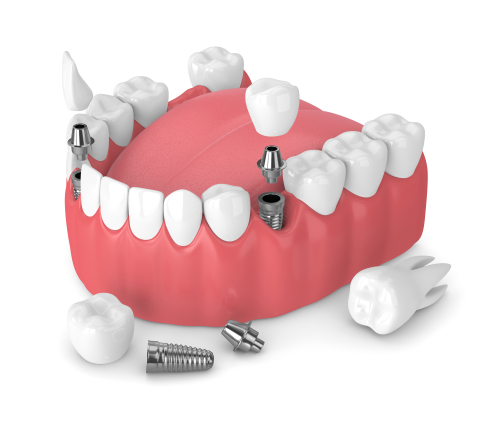 If you want the most effective and natural-looking prosthesis, a dental implant may be the solution for you.
Implants are indistinguishable from your other teeth. They can last for many years—even a lifetime, when maintained properly.
Additionally, the titanium anchor supporting the implant stimulates bone growth, which is an important factor in the jawbone’s health.
Dental implants require a surgical procedure to anchor the prosthesis. Surgery involves placing a titanium anchor that will bond with your jawbone, providing a strong foundation for the implant.
After the implant has been placed, you have a permanent replacement that looks exactly like your natural teeth. You will be able to chew and speak as if you had never lost a tooth.
Dental Crowns
Dental crown placement is one of the most common restorative procedures performed in the U.S. Patients who are unhappy with a discolored or uneven tooth can find an easy fix with a crown, which also helps to preserve the tooth from decay.
Dental crowns are remarkably versatile. They can improve the strength, size, and appearance of your natural teeth. Dentists also often place crowns to protect teeth after procedures such as root canal treatment or dental implant surgery.
Crowns may be made of porcelain and ceramic, gold or base metal alloys, stainless steel, or some combination of these materials.
Dental Bridges
Like a dental crown, a dental bridge is a fixed prosthetic device. But where a crown usually serves a restorative purpose (to “cap” a damaged tooth or implant), a bridge is a replacement for one or more missing teeth.
Bridges hang in the gap of the missing teeth, attached to the adjacent ones. They restore aesthetics and functionality, allowing for better chewing and speaking. Dental bridges also help maintain facial structure and prevent remaining teeth from shifting out of position.
The most common materials used to make dental bridges include porcelain and ceramic (popular choices for their natural appearance) and metal alloys (gold and silver, usually used for molars or other teeth not visible when smiling).
Dentures
Dentures are a removable dental prosthesis that can function as a partial or complete replacement for missing teeth.
A partial denture consists of a small set of replacement teeth attached to a gum-colored base, held together by a metal frame. It fills in the spaces left by the missing teeth and prevents other teeth from shifting.
A complete denture has a similar structure but is a full set of false teeth. Dentists place complete dentures about eight to 12 weeks after teeth have been extracted.
Patients missing many teeth often prefer dentures because they are the most affordable dental prosthetic available.
What Is Prosthodontics?
Prosthodontics is the branch of dentistry that specializes in using dental prosthetics to replace missing teeth and reconstruct damaged teeth and other parts of the mouth.
Prosthodontists (the type of dentist who does implants and related procedures) undergo specialized training that lasts an additional three years beyond dental school. This rigorous training emphasizes expertise in advanced dental procedures, including the design and fitting of dentures, crowns, bridges, and implants, as well as the management of complex dental and facial anomalies.
Prosthodontists are also skilled in cosmetic, reconstructive, and implant dentistry. They are able to restore optimal oral health and function for patients with precision and artistry, and are often called “architects of the smile.”
Making Decisions About Dental Prosthetics
Whether you have lost or damaged teeth due to tooth decay, gum disease, oral cancer, an injury, or a congenital defect, a prosthodontist can help you.
Your prosthodontist will decide on your course of treatment based on:
- the particular condition of your teeth
- your dental and medical history
- your personal preferences
You will also want to consider whether you want or need a fixed or removable prosthetic. Crowns and bridges are fixed. Dental implants are arguably the “most fixed” option, since they often will not need to be replaced or repaired.
Both fixed and removable dentures are available options.
In some cases, your prosthodontist may design a combined approach (for example, attaching a crown or a bridge to a dental implant).
Seek the Expertise of Penn Dental Family Practice
Replacement of missing teeth and restoration of damaged ones are complex treatments requiring the expertise of a qualified dental professional.
Consult with an expert prosthodontist in Philadelphia and the surrounding area at Penn Dental Family Practice (PDFP). Our prosthodontists are leaders in the field. Indeed, many of them teach the next generation of providers at the University of Pennsylvania School of Dental Medicine.
Download our free flyer to discover more about how dental implants can help you get the smile you want and deserve, then make an appointment online or call us at 215-898-PDFP (7337).