Resource Library

Start Reading


If you routinely drink coffee in the morning, you’ve likely made some choices you haven’t given much thought to in a while. You’ve chosen the blends you like. You’ve chosen your favorite mugs. You’ve chosen whether to add cream and sugar or take your coffee black.
But here’s a choice worth revisiting to make sure it’s the best one: Do you brush your teeth before or after your coffee?
Deciding when to pick up your toothbrush before or after you pick up and put down your coffee cup can significantly impact your mouth’s health. Keep reading to find out why, and the morning coffee and oral hygiene routine we at Penn Dental Family Practice (PDFP) recommend.
When patients ask, “Should I brush my teeth before or after my coffee?”, we tell them that understanding the chemistry of coffee and how it affects teeth is critical to the look and longevity of their smile.
Oral health relies on a balanced pH, the measure of acidity (high concentration of hydrogen ions) or alkalinity (low concentration of hydrogen ions). A healthy mouth maintains a slightly neutral to alkaline pH, ideally between 6.2 and 7.6.
Coffee typically has a pH around 5. While acids in coffee are key to its taste and flavor, they also act as chemical solvents that dissolve the minerals in your teeth’s enamel and temporarily soften it.
Your saliva naturally works to neutralize this acidity and remineralize the enamel. But it takes saliva at least half an hour to an hour to remineralize your teeth after you drink your coffee.
If you brush your teeth while your enamel is softened by acid, you are essentially scrubbing away the most vulnerable part of your teeth.
Think of your enamel as a sponge that needs to be hardened. Brushing your teeth before it does leads to microabrasions. Those microabrasions can weaken tooth structure and increase your susceptibility to staining and tooth decay.
Brushing immediately after drinking coffee also spreads the acidic residue across your teeth and into the crevices, meaning they must endure longer exposure to the damaging acid.
In short, if you brush as soon as you’ve had your last swig of coffee, you’re dealing your teeth a “one-two punch.” The chemical erosion of the coffee, combined with the mechanical abrasion of the bristles, leads to thinning enamel.
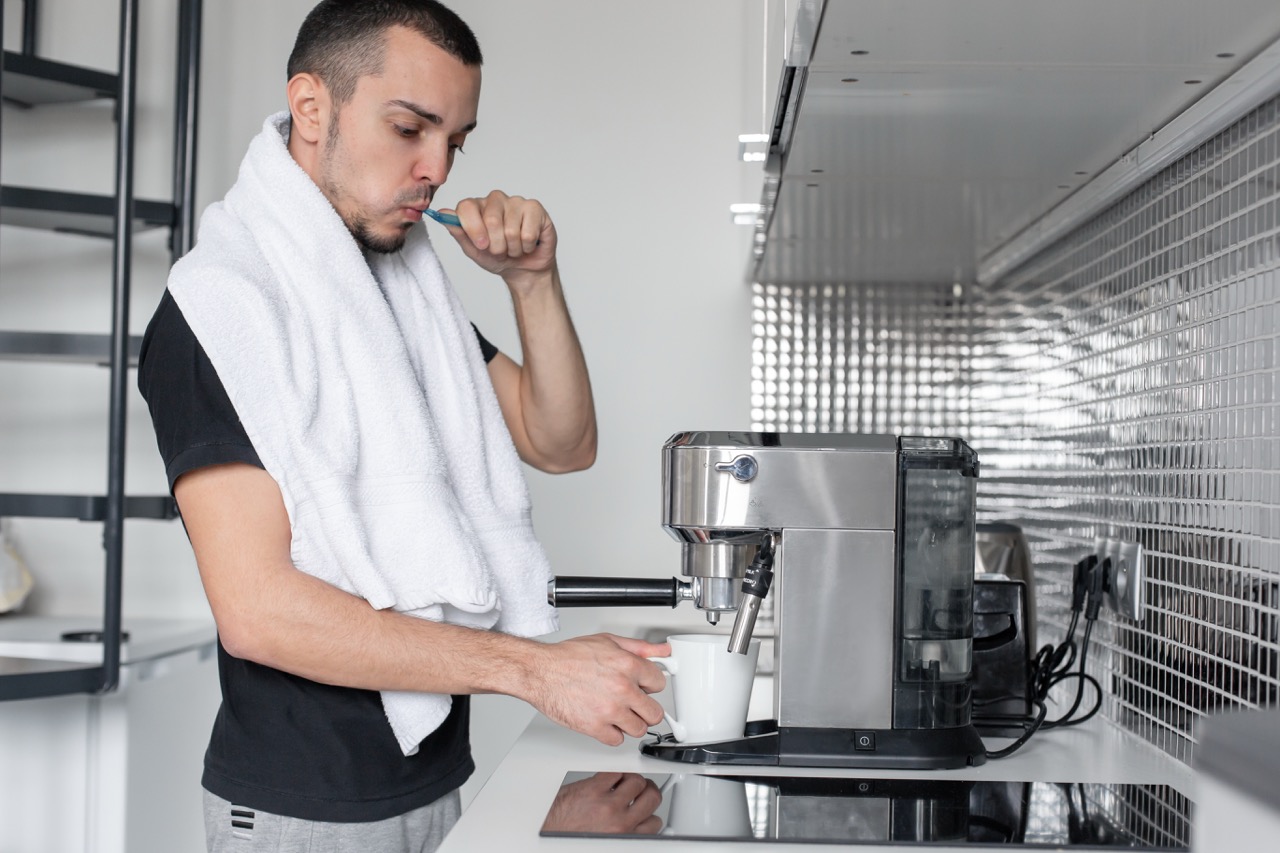 When thinking about whether it’s better to brush teeth before or after coffee, brushing beforehand may seem counterintuitive. After all, who wants to go through the rest of the morning with coffee breath?
Even so, brushing first thing in the morning, before you head for the coffee pot, makes good scientific sense.
While you sleep, your saliva production decreases, allowing bacteria to thrive. Brushing your teeth immediately on waking up clears this bacterial biofilm (plaque) away before it can harden. The fluoride in your toothpaste also creates a protective layer that will act as a shield against the acidity of your morning brew.
In addition, staining pigments in coffee bind much more aggressively to plaque than they do to clean enamel. When you brush your teeth before you drink your coffee, you reduce the surface to which those staining agents can adhere.
In addition, the act of brushing your teeth stimulates your saliva flow. Saliva is your mouth’s primary defense because it provides essential calcium and phosphate ions to keep enamel strong all day long.
 Brushing teeth right after your coffee is still a bad idea, even if you’re not taking it black. Dairy can slightly buffer coffee’s acidity, but the sugars often associated with flavored coffees and drinks like lattes offset this benefit.
Bacteria thrive on sugar, producing even more acid. “If you put sugar into coffee,” Dr. Mark S. Wolff, Dean of the University of Pennsylvania School of Dental Medicine, told Prevention magazine, “it feeds the bacteria and elevates the risk of tooth decay.”
Worth noting: Cold brew is generally less acidic than hot-brewed coffee. Its lower acidity profile may be slightly gentler on your enamel. However, both hot and cold brew can contribute to staining.
Here’s the step-by-step oral health routine we recommend coffee drinkers follow:
You can also consider drinking your coffee through a straw to minimize direct contact between it and your teeth. And chewing xylitol gum naturally stimulates saliva flow, speeding up the neutralization of acid in your mouth.
 At PDFP, we don’t generally tell patients to cut out coffee altogether in their pursuit of better oral health. Many of our dentists enjoy a good cup of joe in the morning as much as anyone else does.
But when it comes to deciding whether to brush teeth before or after coffee, the answer is clear: To protect your enamel as much as possible, brush your teeth before your first sip.
By removing plaque early in the morning and letting your saliva work its natural restorative magic, you protect your smile from both chemical erosion and unwanted staining.
And if you enjoy a post-coffee brush? Wait 30 minutes to avoid causing irreversible damage. Adopting this simple routine ensures your daily caffeine habit doesn’t come at the expense of your long-term oral health.
For more expert guidance on keeping your teeth, gums, and smile as healthy as they can be, make your next or your first appointment at PDFP online today, or call us at 215-898-7337.